
Irrigation Rolls
| Specification | Details |
|---|---|
| Material | Polyethylene (PE) |
| Color Options | Transparent, White, Yellow, Green, Blue, Black, Milky, Silver, etc. |
| Thickness | 400 to 700 microns (Customizable) |
| Width | 5 to 25 cm (Customizable) |
| Durability | 6 to 24 months |
| Packaging | Rolls wrapped with PE films, inner Core diameter 76 mm, supported with plastic lids on both ends |
Product specifications & additives can be customized based on customer request & environmental conditions.
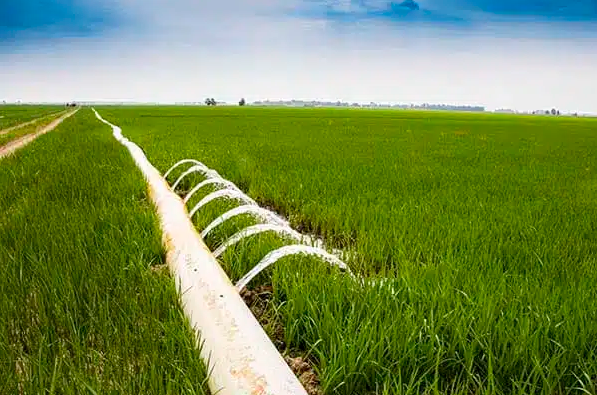
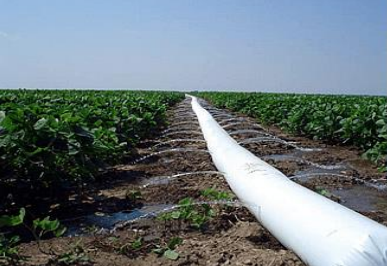
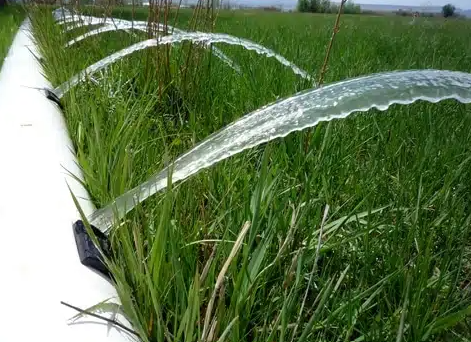
Irrigation roll, or lay flat irrigation hose, is a seamless multilayer polyethylene pipe made by combining low-density and high-density polyethylene, UV additives if necessary, and other materials. It is simply laid on the ground and connected to any water source such as ponds, wells, or water canals, requiring low water pressure. This method is one of the fastest, easiest, and most cost-effective irrigation techniques.
The irrigation pipe is a soft and flexible plastic tube designed to deliver water directly to plants. When empty, it appears flat, but when water flows inside, it inflates. After irrigation, it returns to its flat shape.
Irrigation using polyethylene pipes is considered a pressurized irrigation system, operating at pressures ranging from 0.5 to 2 atmospheres. Initially, the pipe is connected to a water source like a pond, well, or canal, and water flow is maintained by a pump providing the necessary pressure.
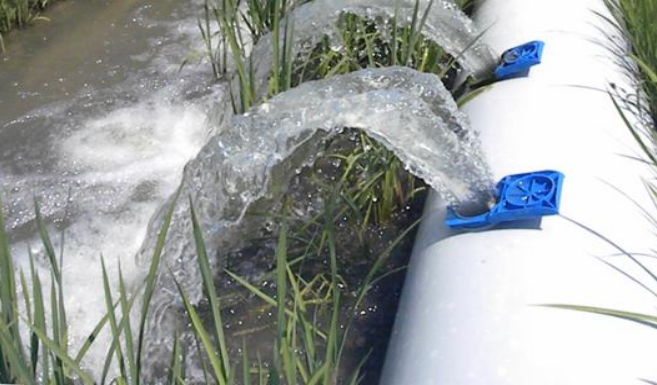
The irrigation pipe has holes (emitters) spaced differently depending on the crop type and planting method. The most common emitter spacing is 20 and 30 centimeters, but distances of 10, 15, 25, 40, 50, 60, 80, and 100 centimeters are also available. Each emitter delivers 0.8, 1.3, 1.5, 1.6, 2, 2.5, or 3.8 liters per hour. The flow per meter can be calculated easily based on the number of emitters per length.
Irrigation tubing is a superior alternative to rigid metal pipes, offering efficient irrigation with minimal water loss. Key benefits include:
- Water is delivered directly to plant roots without surface runoff, minimizing water usage and simplifying weed control.
- Its flexibility allows easy installation on uneven or sloped terrain.
- Enables uniform injection of soluble fertilizers across the field.
- Minimizes leaf wetness, reducing leaf burn risk.
- Eliminates the need for open canals, easing farm machinery movement.
- Reduces labor requirements compared to traditional methods.
Additional features:
- Flexible and easy to handle
- Compact and portable during work and storage
- Resistant to environmental factors and corrosion
- Suitable for all seasons and weather conditions
- Reusable until worn out
- Saves water, energy, fertilizers, herbicides, and labor costs
- Expands cultivable area and crop yield
- Facilitates machinery use by removing traditional irrigation barriers
- Simple installation and maintenance without expert labor
- Fully recyclable
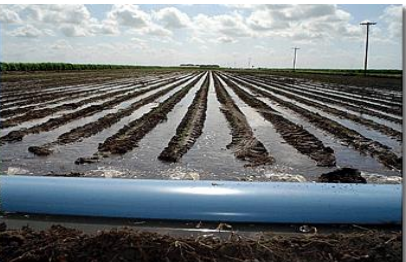
Polyethylene irrigation rolls are widely used in agriculture for row and surface irrigation systems. They efficiently deliver water and fertilizers directly to crops in farms, greenhouses, and nurseries. Due to their low cost, flexibility, and ease of installation, they are preferred for small to large-scale farming, horticulture, and landscape irrigation. Additionally, pipes without emitters are used in industrial water transfer, livestock farms, and drainage systems. Their versatility and durability make them suitable for diverse environmental and operational conditions.
To estimate the amount of irrigation tubing required per hectare, simply divide the total area (10,000 square meters per hectare) by the spacing between irrigation tapes in meters. For example, with a spacing of 75 cm (0.75 meters), dividing 10,000 by 0.75 yields approximately 13,300 meters of irrigation pipe per hectare. This calculation is an estimate and actual requirements may vary depending on crop type and planting density.
Product Name: Irrigation roll
Other Names: Watering pipe, Lay flat irrigation hose, PE irrigation roll, Poly-Pipe Irrigation, Poly-Tube Irrigation
Application: Low-pressure irrigation in general construction projects, water transfer and drainage; irrigation in agricultural industry; surface irrigation systems
Features:
- Flexible
- Easily packed and carried (during work and at the end of the season)
- Resistant to ambient conditions and corrosion
- Applicable in every season and weather condition
- Reusable until spoiled
- Saves water, energy, fertilizer, herbicides, and labor costs
- Increases cultivation area and crop yield
- Facilitates machinery use on farms by removing traditional irrigation barriers
- Requires no expert labor; quick and easy installation and maintenance
- Recyclable
Thickness: Typically 400 to 700 microns
Width: Typically 5 to 25 cm (2 to 10 inches), customizable
Color: Transparent, Yellow, Green, White, Blue, Black, Milky, Silver, etc. (based on customer request)
Durability: 6 to 24 months
Packaging: Rolls wrapped with PE film, inner core diameter 76 mm, core reinforced with plastic lids at both ends
Why should irrigation plastic be used?
This system aims to save water and improve overall plant growth efficiency in agriculture.
In which regions is irrigation plastic used?
It is ideal for dry and water-scarce areas where water loss during irrigation is high, serving as a better alternative to traditional methods such as basin, furrow, and channel irrigation.
Which crops are suitable for irrigation pipes?
Irrigation tapes are best for dense and row crops such as various vegetables, corn, wheat, forage crops, watermelon, melon, tomato, onion, potato, strawberry, sunflower, sugar beet, and cotton. They are usable in fields, greenhouses, and nurseries.
What factors determine the price of irrigation plastic?
Pricing depends on length, thickness, additives, and raw materials. For precise pricing, please contact Romen Plast Company.